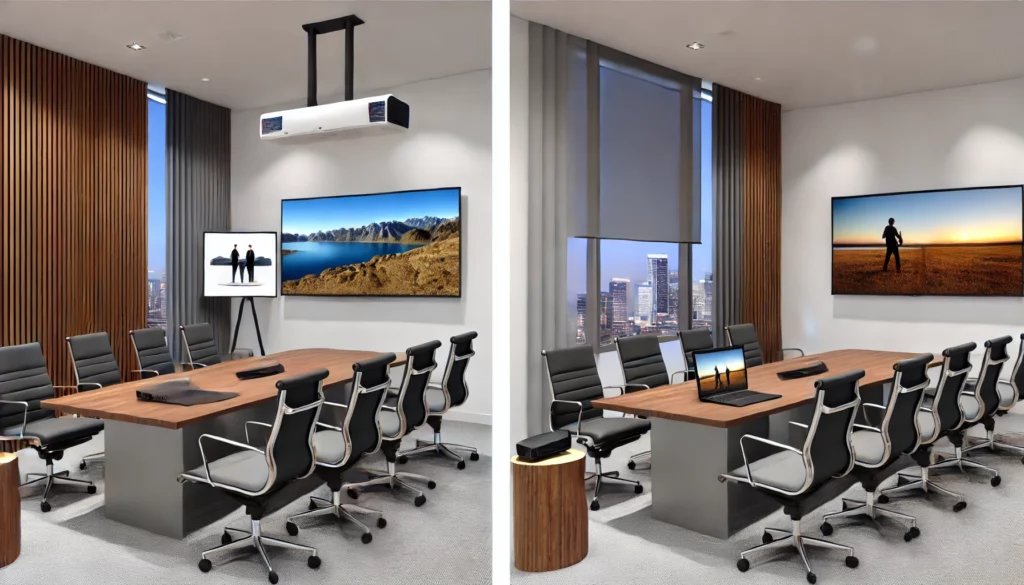
A conference room’s display solution must be chosen with care.
Both TVs and projectors offer special benefits fit for distinct purposes.
Singaporeans in offices want premium screens.
Making a decision depends on knowing the particular needs and room restrictions.
Introduction
Should your Singapore business conference room’s display system be upgraded?
The scene of interactive and visual technology has evolved greatly, providing a wide range of strong alternatives for corporate settings.
Still, it’s more about what’s useful and effective for the particular requirements of the office than about what’s current.
Knowing the advantages and possible disadvantages of projectors and TVs will enable you to decide which one best meets your company requirements.
These two technologies will be discussed, which will help you to find the correct solution.
Cost Comparison
For bigger displays, projectors typically provide a more cost-effective solution when weighing options.
Over time, though, televisions might have lower maintenance expenses.
Projectors typically have smaller initial costs, which is good for offices in Singapore trying to stay under control financially.
However, televisions’ attraction stems from their often longer lifespan and need for less bulb changes.
The ultimate choice will rely on the particular financial situation of every office.
Although a first projector could be more affordable, it is impossible to ignore the long-term cost-effectiveness of televisions because of their durability and reduced maintenance. Therefore, the most wise decision will depend on thorough evaluation of the whole cost of ownership.
Space and Organisation
When examining the spatial dynamics of an office in Singapore, projectors offer a major benefit particularly for those with limited space.
Large screen sizes they may provide can be obtained without using actual floor or wall space.
Projectors do, however, need appropriate mounting and wiring as part of their installation.
Conversely, TVs are easy to install and usually just need a wall mount.
TVs could be the best option in offices with little ceiling height or those that want a simple arrangement.
The best option will rely on one’s priorities about possible space efficiency against simplicity of construction.
Thus, it is important to assess which configuration fits office requirements the best.
Picture Quality
For Singapore offices, picture quality is a major consideration when comparing projectors to TVs.
With their big, vivid displays, especially when combined with cutting-edge image-enhancing technologies, projectors—in their most recent forms—offer a shockingly immersive viewing experience.
Presenting an enhanced atmosphere for presentations and group meetings, modern projectors now include high-density resolutions that can approach, sometimes even exceed, the visual quality of conventional televisions.
Still, televisions offer their better colour accuracy and visual clarity.
TVs provide incredibly sharp and vivid images that can bring even the most intricate scenes to life as 4K and even 8K options become standard.
Their constant performance under different lighting environments adds even more to their attractiveness since it guarantees best picture quality all day long.
Regarding visual quality, both choices have certain unique benefits.
While a high-end television may provide crystal-clear images ideal for comprehensive presentations and video conferences, a high-end projector can deliver a movie-like experience to big conference rooms.
Making the optimal decision depends on knowing the particular requirements of the company and meeting room.
Functionality and Features
With their customisable screen dimensions and positioning, projectors provide amazing flexibility allowing different room sizes.
They are the best choice for dynamic workplace environments since they allow huge display solutions for big conference rooms free from fixed screen sizes.
Advanced projectors also have wireless connectivity and little input latency, therefore enabling flawless interaction with contemporary meeting technologies.
Projectors are an attractive choice for meeting rooms looking for adaptable display solutions because of their flexibility.
On the other hand, televisions shine in offering constant performance with less required setup.
They include built-in smart features that let users quickly access several tools and platforms meant to improve cooperation.
In essence, the choice between a projector and a television should be motivated by the particular requirements and particular purposes the workplace needs.
Although televisions provide a plug-and-play convenience with great consistent quality, projectors give unmatched versatility and fit for big presentations.
To make the best decision, offices in Singapore should evaluate their technical needs, usage patterns, and dimensions of meeting rooms.
Energy Efficiency
Given increasing running expenses and environmental sustainability, energy efficiency is a major factor for Singaporean offices.
TVs and projectors each show different energy consumption trends.
Depending on their brightness and lifetime of usage, projectors sometimes use bulbs with different power consumption.
Modern LED and OLED televisions, on the other hand, are meant to be more energy-efficient, thereby providing workplace settings with a more sustainable option.
Singapore offices can have both exceptional display quality and low environmental effect by assessing energy labels and adding energy-saving technologies.
Use Cases
In the framework of offices in Singapore, what are the special situations when projectors or televisions are preferred?
Projectors in a big conference room allow material to be shown on wide surfaces, therefore serving bigger audiences.
Smaller conference rooms, on the other hand, are perfect for short, informal presentations as they gain from the instant configuration and consistent picture quality of televisions.
Interactive projectors with touchscreen capability can help to increase involvement and participation in cooperative settings requiring regular brainstorming sessions.
In the end, assessing the particular requirements and dynamics of every conference room will direct Singaporean offices towards the ideal display option.
Conclusion
Selecting the ideal display system for Singaporean meeting rooms calls for a customised strategy.
One must take room size and use into consideration.
While TVs flourish in small areas with immediate setup needs, projectors shine in big, dynamic situations.
Singapore offices should review their particular needs and research both technologies to make wise choices.
With careful consideration, one will surely identify the best display solution to improve productivity and teamwork.